
Senior Proposal Progress Log
Break Weeks (Dec 14 - Jan 11,2020)
-Procuring parts for the AC system such as the evaporator and the pressure switch. Procuring and testing solar panels for the project.
Week 16 (Dec 14,2020)
The team was given the opportunity to present to a UCF start-up called Capacitech. We presented our project and discussed ways in how we could use their wire-shaped super-capacitor technology in our systems. We are considering in using this for our power module and tent deployment module. The team is currently testing the technology and seeing where we can fit it in our system.

Week 15 (Dec 7,2020)
Joseph designed the possible circuit diagram for our system. This is not a final diagram but it incorporates how power will be distributed to all the modules in our system.

Week 14 (Nov 30,2020)
The team presented in front of industry professionals. We presented confidently and successfully proposed our project. We were presented with questions that made us think of better ways to approach our project. Overall, we believe we did well and look forward to starting the project.
Week 13 (Nov 23, 2020)
The team primarily focused on writing the report and getting ready for the presentation. Parts for the project are still being shipped and the team is waiting to receive all the parts before continuing the project.
Week 12 (Nov 16,2020)
Research was conducted to estimate the Prius AC compressor power consumption. From previous research it was found that the Prius compressor has a cooling capacity pf 3.4KW. In our research this week, we found out that given the rating of most AC compressor, maximum current will be approximately 8 amps. This current is the approximate max current of the motor in the compressor. We also know that rated current of the compressor can be approximately 2-4 time less than the starting current.
Given that the compressor has a nominal voltage of 206V, this would imply an approximate power consumption of 412-1648W for that compressor.
We also approximated the power consumption of the compressor using an estimate SEER of 12 using the following formula:
Cooling Capacity / Power consumption = Seasonal Energy Efficiency Ratio
=> 3.4KW / 12 = 283 W.
We elaborated further on the different parts and their role in chapter 2 of the report.
We conducted weight measurements on parts and found out that the compressor weighs about 12 pound, the condenser weighs about 5 pound, the fans weighs about 7 pound and the evaporator about weighs about 3 pound.
Refrigerant capacity of the Prius AC system is 1.14 pound with 0.93 pound of oil. This information was found out upon calling a local auto parts store and requesting info on the cooling capacity.
Discussed weight of the system in report and briefly explain portability.
Week 11 (Nov 9,2020)
Main components such as the VFD, battery, temperature sensors, raspberry pi microcontroller, battery level sensor, power inverter and solar charger controller were researched and ordered.
The team arrived at a better tent design that involve solid support and electromechanical deployment for the area where the panels will be.
The rest of the tent will be a double layered system with stretchable fabric and insulating fabric sawed as a double layer that enclose the rest of the tent.
Motivation section in chapter 1 of the report was revised as requested by the professor. The section needed more explanation to clarify motivations.
Chapter 2 & 3 report writing.
Week 10 (Nov 2,2020)
The team got together to discuss the tent deployment system. We needed something rigid but could also be stored in a small package. So we agreed upon a hybrid between corrugated plastic and inflatable material system using a PVC-Coated Polyester Fabric as the skeletal system for the support structure and a double layered light fabric as the outer layer. We decided on a double layered material to keep the tent insulated. We are also considering on adding a reflective coating on the outside layer to reflect sunlight and reduce the heat inside the tent.
We are considering PVC polyester fabric because it can be folded and still have excellent tensile strength, its waterproof and does not fray, rip or tear, making it strong and durable for the applications that we need.
We were inspired by the material used in Inflatable Stand Up paddle boards, which typically use two layers of this polyester fabric and applying a method called "drop stitching" which is a process that uses up to 400 individual needles on a drop stitching machine to sew tens of thousands of fine threads between two separate layers of fabric. The resulting length of flexibly-joined fabric materials create a very strong product that expands and contracts to the shape of a paddle board. The end product is capable of withstanding the high inflation pressures needed to make an inflatable SUP rigid enough to stand and paddle on.
We will be exploring methods on how to apply this technology into our design.


Week 9(Oct 26,2020)
-
Research on solar charge controller types:
Although MPPT(Maximum Power Point Tracking solar charge) controllers are more power efficient and can self regulate to match the input power to output battery power, PWM (Pulse Width Modulation) is found to be a better fit for the CASA system. They are simpler than MPPT controllers and thus generally less expensive according to news.energysage.com. PWM controllers works by slowly reducing the amount of power going into the battery as it approaches capacity and when battery is full, it maintains a state of "trickle" to keep the battery topped off [17]. Given that its basic functions meets our need at a much better price, PWM is the best fit for a low cost budget.
-
Research on building material:
Corrugated plastic; "Corrugated plastic is rigid, water-proof, and washable. It can be reused and regulated, can be cut to size, can be folded and shaped and is lightweight."[18].
Image of corrugated; obtained
from Walmart's website.
Advantages and uses of corrugated plastic: [19]
-
Research on switches for the tent deployment process: [20]
Due to the fact that the microcontrollers being used to program sequence control in the system might not be able to provide adequate power directly to the components in the deployment system, the microcontrollers will be used to program the switches that provide power to those components.
**PNP BJTs and N-channel MOSFET in Enhancement mode are under consideration
Image of a Mofset [22]
-
Research into digital potentiometer:
Digital potentiometer are needed to program and control a range of operating frequency in order to control/limit power consumption of the AC compressor. As it was previously found out in week 7 that the AC compressor is frequency controlled, a potentiometer is needed to control the output power of a VFD. [21]



Week 8(Oct 19,2020)
-
Working on deployment design
-
Starting prototype build and designing programming sequence.
-
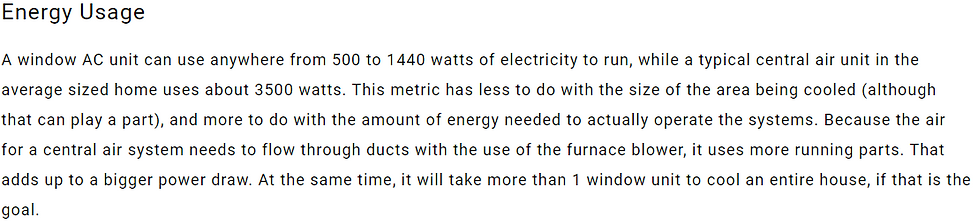
Research into approximate power consumption of a AC units: [8]
AC compressor is found to consume an approximately 650-1750W. [16]
Week 7(Oct 12,2020)
-
We acquired a few parts so that research into the components that will go into the project design can more specific to components specs and operation. Acquired components are as follow:
-
Acquiring the compressor guided our focus into researching circuit designs and operation/control of VFDs for a 206V AC compressor: VFDs are used in combination with an AC compressor make the entire HVAC unit more efficient [11].


Week 6(Oct 5,2020)
We are currently learning python for the purpose of programing the feedback response system of the AC unit.
We also researched compressor control unit to a better understand control parameters of a compressor. AC compressor options for best fit in a power efficient system: Some compressors are Voltage controlled or current controlled but others are frequency controlled and it is found out that frequency controlled units are more energy efficient.
Week 5(Sept 28,2020)
We discussed options for the self deployment feature of the tent. We decided to go with an inflatable frame, as shown on the link [15], mixed with a a motorized arm that can lift the solar panels.
We also worked on a proof of concept for running a 700W window AC unit on 3*100W solar panels in conjunction with 2*(12V*19Wh) batteries with a 1000W inverter.

Week 4(Sept 21,2020)
We researched the feasibility of a solar powered AC unit. We found that there is a product on the market for a portable AC unit. This video linked will show that the portable AC unit can be powered through solar if coupled with a battery. [27]
Week 3(Sept 14,2020)
An additional idea was proposed, the Recycling shredder. Additional data was presented to support all previously proposed ideas. Dr. Ejaz suggested that the group lean towards the self-deploying tent idea and a redesign of its block diagram. Time and effort table was also updated.
Week 2(Sept 7,2020)
Researching ideas. A total of 3 ideas were proposed and they are as follow: Drone, self-deployable tent, Hydrogen fuel cell generator. Professor suggested deeper research for proof of concept and feasibility of ideas.
Week 1(Aug 31,2020)
Dr. Ejaz went over the syllabus in a zoom meeting to discuss website requirements, criteria for possible proposal ideas, important dates, proposal report and presentation.